The Belief We Call Money
How energy, attention, and vision all slipped their anchors in our lifetime, and why the bill is now coming due.
Forty-seven seconds.
That is the average length of time an adult now holds attention on a single screen before switching to something else. Not per hour. Per task. The median is forty seconds, which means half of all observed focus windows are shorter than that. Gloria Mark, the informatics researcher at UC Irvine who has measured this for twenty years, watched the number fall from two and a half minutes in 2004, to seventy-five seconds by 2012, to the wreckage we are currently living in. By the time you finish reading this paragraph, statistically, you will have switched contexts or be on the verge of it. Your phone will buzz. A tab you forgot about will demand its cut. You will come back to this sentence, if you come back at all, with slightly less of whatever was here when you left.

Take that number and stack it next to two others.
In December of 2025, the regional transmission organization that manages the electrical grid for sixty-five million Americans held its annual capacity auction. The clearing price hit the federally mandated cap of $333.44 per megawatt-day, a third consecutive record, and for the first time in the organization's fifty-year history, the auction failed to secure enough power to meet its reliability threshold. The shortfall was 6,623 megawatts, roughly the annual consumption of five million American homes. Ninety-seven percent of the new demand came from data centers being built to train and serve artificial intelligence. The lights will still come on next winter. They will just cost more, and there will be a little less margin between keeping them on and not.
At roughly the same moment, OpenAI closed a financing round valuing the company at eight hundred and fifty billion dollars. Anthropic reached three hundred and eighty billion. xAI, two hundred and thirty. The AI coding assistant Cursor hit two billion dollars in annual recurring revenue and opened talks at a fifty billion dollar valuation, which would make it the fastest business software scale-up in recorded history. The combined private valuation of the top ten American artificial intelligence companies now exceeds two trillion dollars, roughly equivalent to the GDP of Italy.
Forty-seven seconds. Six thousand six hundred megawatts short. Two trillion dollars.
These are not three separate news stories. They are the same story told from three angles, and the story is about what is finally coming due.
The three primitives
The argument I want to make in this essay is that three things undergird everything humans have ever built, and that all three are now simultaneously breaking through constraints most of us did not know existed. Call them the primitives: energy, attention, and vision.
Energy is the physical capacity to do work. The kilowatts and the calories, the grid and the gut. It runs your body, your car, the aircraft you might have been on today, and the server farm that trained the model that wrote the news alert you half-read this morning before putting the phone down and forgetting what it said.
Attention is the cognitive capacity to bring your mind to bear on something for long enough to understand it, change it, or be changed by it. It is the difference between having eyes on a thing and actually seeing the thing. It is the faculty William James, writing in 1890, called the root of judgment, character, and will.
Vision is the teleological capacity to know what you are doing and why. At the personal scale, it is your picture of your own future. At the civilizational scale, it is the shared story a society tells itself about what it is for. Without it, energy dissipates into motion without purpose, and attention fragments into notifications without meaning.
Money is the fourth element in this picture, and it is the one most people mistake for the system itself. Money is not a primitive. It is a belief: the most successful shared fiction humans have ever invented. A dollar bill cannot heat your house, feed your child, or generate a single watt of electricity. It does what it does because seven billion people have agreed it does, and because that agreement is renewed every day by the energy they spend, the attention they pay, and the visions they choose to participate in. Strip the belief and the paper is just paper. Strip the energy backing the belief and the belief evaporates within months. The four elements (vision, attention, energy, money) are not a list of separate things. They are a cycle, each one creating the conditions for the next, each one collapsing if the others fail.
For most of recorded history this cycle was held in rough balance by the fact that money was forced to be a reasonably honest claim on energy. To have it you had to mine silver, grow wheat, build a ship. Now money is a claim on nothing in particular, which is why the national debt of the United States crossed thirty-eight trillion dollars in October 2025 and is approaching thirty-nine trillion as I write this, and why gold is trading at forty-seven hundred dollars an ounce, and why Bitcoin, a twenty-six-year-old mathematical protocol born as a protest against bank bailouts, now sits on the balance sheets of sovereign wealth funds. The belief is being stress-tested in public.
The central claim here is that the cycle has been broken at three different points within the living memory of people still drawing breath. Money slipped from energy on August 15, 1971. Vision slipped from civic imagination on December 19, 1972, the afternoon Apollo 17 splashed down in the Pacific. Attention slipped from voluntary control sometime in the mid-2000s, probably on the night of September 5, 2006, when Facebook launched the News Feed.
Each break has produced its own exhaustive literature. None of them has been understood as the same break, because the cycle they belong to has rarely been described. The three breaks have never arrived at their hard constraints simultaneously. Until now.
When the anchors held
The pre-modern world treated all three primitives as moral categories because it had no other language available. Before 1700, there was no clean scientific vocabulary separating body from spirit, physics from ethics, motion from meaning. The wisest minds of every tradition used breath-words to name what we now call energy. The Greeks said pneuma. The Indians said prana. The Chinese said qi. The Hebrews said ruach. Each term meant, roughly, the ordered animation of matter into life. Each carried, inseparably, an ethical charge. Energy was not amoral fuel to be burned for any purpose. It was the sacred current of existence, to be directed toward ends that justified it.
Attention was equally moralized. The Stoics called it prosoche, continuous vigilance, and they considered it the single practice that separated the free man from the slave. Epictetus, born into slavery, argued that the Roman emperor was in fact more enslaved than any farmhand, because he had surrendered his attention to the whims of senators and soothsayers. Marcus Aurelius, the most powerful man in the ancient world, filled the private notebooks we now call the Meditations with reminders to himself to keep his attention from wandering. The Christian contemplatives who inherited the practice called it nepsis, watchfulness. The Buddhist tradition called it sati, the first of the seven factors of awakening. Across radically different cosmologies, the teachers agreed on one point: a human being without governed attention is not yet fully a human being.
Vision was the province of the prophets and the philosophers. Plato's allegory of the cave is the founding myth of the Western intellectual tradition, and its entire content is an argument about vision. Most people live in shadows. A few glimpse the Good. Those few are obligated to descend and try to show the others what they saw. The Hebrew Bible reports the same structure more bluntly. "Where there is no vision, the people perish," says Proverbs 29:18 in the King James rendering, and although modern scholars point out that the verse actually refers to prophetic revelation rather than corporate strategy, the accidental mistranslation has had the interesting effect of being almost exactly right. Without some coherent picture of what the future is for, a community does, in fact, fall apart.
Money, in this earlier world, was recognized as a useful but morally dangerous tool. Aristotle's Politics distinguished oikonomia, the management of the household for the sake of the good life, from chrematistike, the pursuit of money as an end in itself. Aristotle considered chrematistics unnatural. Usury, the charging of interest, he considered the most unnatural form of it, because money was supposed to be a measure, not a thing that could breed more of itself. Thomas Aquinas inherited this view and built the medieval canonical prohibitions on interest around it. For most of human history, most serious thinkers agreed that something had gone wrong when a society confused its coupons with its substance.
Then the nineteenth century quantified everything.
The century that put numbers on the sacred
In 1824, a twenty-eight-year-old French military engineer named Sadi Carnot published Reflections on the Motive Power of Fire, and in doing so he invented thermodynamics. Carnot was trying to help France catch up to England industrially. What he actually did was demonstrate, for the first time in recorded history, that energy is a real substance with laws that no engineering cleverness can violate. By 1865, Rudolf Clausius had extracted from Carnot's insight the two sentences that remain the most fundamental statements in all of physics: the energy of the world is constant, and the entropy of the world tends to a maximum. Every kilowatt-hour, every calorie, every erg is real. You cannot create it. You can only find it and spend it, and spending it degrades it forever.
At nearly the same moment, William James was inventing modern psychology in a drafty office at Harvard. In 1890, he published the chapter that would define every subsequent conversation about attention. "Every one knows what attention is," he began, in a sentence that has been quoted to exhaustion but still lands. "It is the taking possession by the mind, in clear and vivid form, of one out of what seem several simultaneously possible objects or trains of thought. Focalization, concentration, of consciousness are of its essence. It implies withdrawal from some things in order to deal effectively with others."
Attention, for James, was the active substance of character. A few pages later, on page 424 of a book most people no longer read, he made the ethical claim that reverberates across the hundred and thirty-six years between his moment and ours: "The faculty of voluntarily bringing back a wandering attention, over and over again, is the very root of judgment, character, and will. No one is compos sui if he have it not. An education which should improve this faculty would be the education par excellence."
Compos sui. Self-possessed. Sovereign over one's own mind. James is making the Stoic argument in a Harvard office in 1890: without the capacity to direct your attention, you do not yet own yourself.
The same decades quantified money with equal precision. The classical gold standard crystallized in the 1870s, tethering the global money supply to the thermodynamic cost of prying metal out of rock. The American Coinage Act of 1873 fixed the dollar at twenty dollars and sixty-seven cents per troy ounce of gold, a ratio it would hold for sixty-one years. Britain had done the same in 1816. Germany joined after the Franco-Prussian War in 1871. For the first time in human history, all three primitives were scientifically legible, and all three were, roughly, anchored. Energy had its laws. Attention had its psychology. Money had its metal, which is another way of saying that money was anchored to energy through the physics of mining, and that the cycle was held in honest tension by something physical rather than something purely believed.
Then, starting in 1933, the anchors began to fail one by one.
August 15, 1971
On April 5, 1933, Franklin Roosevelt signed Executive Order 6102 and made it a felony for a private American citizen to own more than a trivial amount of gold. Penalty for noncompliance: ten thousand dollars or ten years in federal prison, which in 1933 dollars was a genuinely ruinous sum. The order was presented as an emergency measure to stop bank runs, and in fact it did stop them. It also detached the domestic American dollar from its gold anchor. Ten months later, the Gold Reserve Act of 1934 revalued gold from $20.67 to $35 per ounce, an instant devaluation of the dollar by nearly seventy percent. The Americans who had surrendered their coins the previous spring at the old price were paid back, a year later, in dollars worth thirty percent less. It was the largest legal financial transfer of its kind in American history to that date, and almost nobody under the age of forty now knows it happened.
The international dollar, however, remained convertible into gold at the new price. This residual anchor survived the Second World War, survived the Bretton Woods conference in 1944 at which John Maynard Keynes argued unsuccessfully for a supranational currency he called the Bancor, and survived Korea and Vietnam. It did not survive Richard Nixon.
At nine o'clock on the evening of Sunday, August 15, 1971, Nixon went on television and, with the bureaucratic passive voice American presidents reserve for their gravest maneuvers, announced that he had "directed Secretary Connally to suspend temporarily the convertibility of the dollar into gold." The word temporarily has now lasted fifty-five years. A few months later, Treasury Secretary John Connally reportedly told the finance ministers of Europe, at a meeting in Rome, "The dollar is our currency, but it's your problem." It has remained their problem, and everyone else's, ever since.
The economist who had predicted this outcome most clearly was not an economist. Frederick Soddy won the 1921 Nobel Prize in Chemistry for discovering isotopes. In the 1920s, horrified by what he saw as the intellectual poverty of economics compared to physics, he pivoted to writing books about money. His central argument, spelled out in Wealth, Virtual Wealth and Debt in 1926, was that real wealth is bound by the laws of thermodynamics, while money, because it is a mere mathematical construct, is bound only by the laws of compound interest. Real wealth therefore grows linearly at best. Money can grow exponentially forever. This structural mismatch, Soddy argued, guarantees that any monetary system untethered from physical reality will eventually accumulate debt claims that exceed the physical world's capacity to satisfy them. He called this "virtual wealth" and he predicted that the attempt to redeem it would produce catastrophic crises. The economics profession of his day treated him as a crank. He is now being read again, mostly by people who notice that the United States is adding a trillion dollars to its national debt every three to five months.
The numbers since Nixon tell Soddy's story with uncomfortable clarity. In August of 1971, the total M2 money supply of the United States was about $685 billion. In January of 2026, it was $22.44 trillion, an increase of roughly thirty-two-fold. The national debt in 1971 was $400 billion. It is now approaching $39 trillion, an increase of ninety-seven-fold. The purchasing power of a 1971 dollar is now approximately fifteen cents, which means a working person today must earn nearly seven times the nominal wage of their grandparents to buy the same loaf of bread. None of this is hidden. All of it is the predictable consequence of a currency that no longer answers to any physical referent. A belief asked to do the work of a substance.
Money was the first link to break. It broke on August 15, 1971. Sixteen months later, a second link would break.
December 19, 1972
Apollo 17 splashed down in the Pacific Ocean at 2:24 in the afternoon, local time, on December 19, 1972. The three astronauts aboard were Eugene Cernan, Harrison Schmitt, and Ronald Evans. Five days earlier, Cernan had climbed back into the lunar module at the end of the last moonwalk anyone has yet performed, and said: "We leave as we came and, God willing, as we shall return, with peace and hope for all mankind." It has been fifty-three years and counting. Nobody has gone back.
The Apollo program is the cleanest example we have of what civic vision actually looks like in practice. It started with a specific picture: an American astronaut on the lunar surface within a decade. It ran on bipartisan political consensus through three administrations and one assassination. It absorbed roughly four percent of the federal budget at peak, more than NASA has had at any point since, employed four hundred thousand people, and produced not just a moon landing but a generation of engineers, an entire commercial supply chain, the silicon industry, the Apollo Guidance Computer that became the conceptual ancestor of every laptop in the world, and a national mood that for a brief window persuaded a deeply divided country it was capable of doing impossible things together.
Then it ended. Within sixteen months of Nixon closing the gold window, the United States ran the last mission of its last great civic project, and has not run another since. The Space Shuttle, which followed, was a maintenance program. The International Space Station, which followed that, was a diplomatic program. SpaceX, which now does most of the actual hard engineering of human spaceflight, is a private company owned by an immigrant who happens to want to colonize Mars. None of these are civic visions in the Apollo sense. None of them organized the country.
What broke between December 1972 and now is harder to pin than the monetary unmooring, because vision is the most diffuse element in the cycle. Vision is the sense, at the scale of a person or a civilization, of what you are actually trying to do. It is what makes any of the other elements worth spending. Without it, attention has nothing coherent to land on, energy gets scattered across a million private goals, and money loses the meaning that shared belief used to give it.
Peter Thiel calls the change a transition from "definite optimism" to "indefinite optimism." The definite optimist has a specific picture of the future and is willing to commit resources to make it real. The indefinite optimist believes the future will be better but refuses to specify how, and therefore commits resources only to diversified financial instruments designed to capture whatever happens. Apollo was definite optimism. The S&P 500 index fund is indefinite optimism. The first builds rockets. The second buys options on the rockets other people build, if they happen to get built.
But the diagnosis is incomplete without the underlying mechanism. Civic vision requires that a society pay sustained attention to a shared picture of its own future for long enough to organize resources around it. Vision is upstream of attention, and attention is upstream of the medium that carries it. Apollo could exist because the medium of mid-century American life (broadcast television and morning newspapers and the office water cooler) was capable of holding a single shared picture across a whole country for a decade. The medium of contemporary American life is not. You cannot hold a moonshot in a forty-seven-second window. You can only hold a reaction to the last tweet about the last post about the last reaction. The structure of the medium is now incompatible with the structure of the thing it used to carry.
What artificial intelligence has done in the last five years is partially fill the vision void by privatizing it. The founders of OpenAI, Anthropic, xAI, and the other frontier labs have, in effect, taken over a function the country itself stopped performing somewhere between Cernan's last footprint and the cancellation of the Saturn V production line. They have pictures of the future. They have committed enormous resources to those pictures. The capital markets have priced them at roughly two trillion dollars across the top ten companies, a staggering number that is only slightly less staggering when you realize it is probably not enough, at the current burn rate, to build the thing they are trying to build.
The best current articulation of this private vision came from Konstantine Buhler at Sequoia Capital's AI Ascent conference. "An agent economy," he said, "is one in which agents don't just communicate information. They transfer resources. They can make transactions. They keep track of each other. They understand trust and reliability. And they actually have their own economy." Buhler is describing a future in which autonomous software negotiates with autonomous software on behalf of humans who have, in effect, delegated their agency to machines. Sequoia believes this is a ten-trillion-dollar opportunity, because it is coming not for the software market but for the services market, which is roughly an order of magnitude larger.
This is either the fulfillment of a centuries-long Enlightenment project or the privatization of vision into the hands of a dozen unelected founders. Probably both. James Carse, in Finite and Infinite Games, would call it the difference between playing to win and playing to continue the play. Apollo was a finite game with a clean victory condition. The agent economy is an infinite game in which the goal is to keep building forever, with no horizon at which the building stops. We have moved, without taking a vote on it, from a civilization organized around finite goals to one organized around infinite ones, and we have done so at the exact moment we lost the attentional capacity to choose either.
September 5, 2006
In October of 1971, two months after Nixon closed the gold window, the polymath Herbert Simon published a short paper titled "Designing Organizations for an Information-Rich World." Simon had won the Turing Award, would go on to win the Nobel in Economics, and was arguably the last human alive to hold serious expertise in every major field related to cognition. Buried in the essay was a sentence that almost nobody paid attention to at the time.
"In an information-rich world, the wealth of information means a dearth of something else: a scarcity of whatever it is that information consumes. What information consumes is rather obvious: it consumes the attention of its recipients. Hence a wealth of information creates a poverty of attention."
Simon was not describing the present of 1971. He was predicting the future, and he was off by about thirty-five years.
The internet arrived in the mid-1990s. Google was founded in 1998. For its first two years, Google operated as a pure academic search engine with no business model. Then the dot-com crash required a business model, and in October of 2000 the company launched AdWords, inventing modern digital advertising and the modern digital economy in the same afternoon. Facebook followed in 2004, and for its first two years was a relatively benign digital directory. On the evening of September 5, 2006, it launched a feature called News Feed, which algorithmically surfaced the most engagement-generating posts from your network.
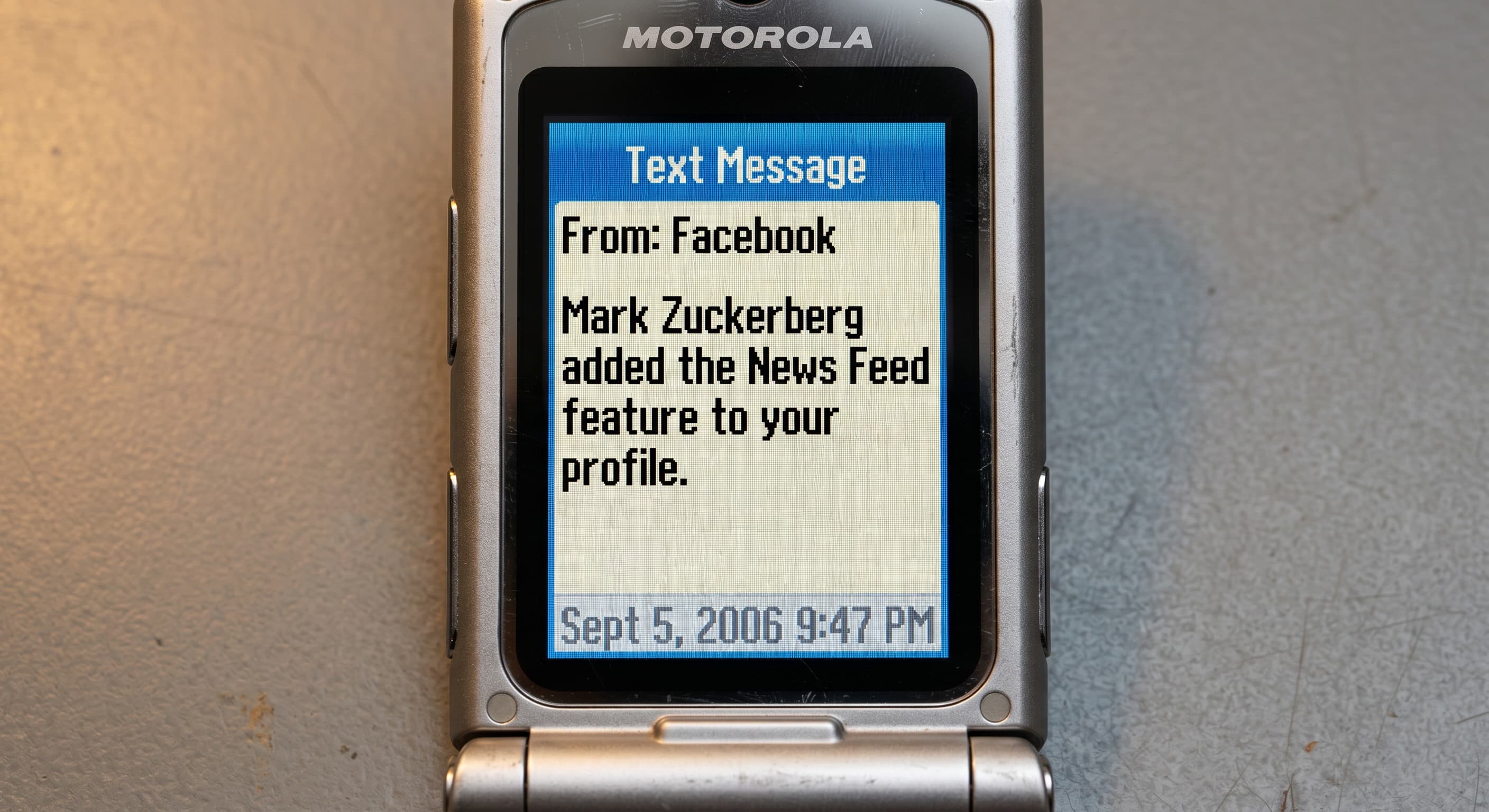
The backlash was immediate. Users hated it. They protested. Groups formed. Mark Zuckerberg posted a blog entry titled "Calm down. Breathe. We hear you." He did not, however, turn off the News Feed. Within months, users had adjusted. Within a year, they could not imagine the service without it. Within a decade, most of the waking attention of most people on Earth ran through systems that looked more or less like it.
The iPhone arrived on June 29, 2007, placing the full harvesting apparatus in every pocket, twenty-four hours a day, in a form factor so elegant that it briefly persuaded us that the thing we were holding was a tool rather than a mouth.
The legal scholar Tim Wu, writing in 2016, called the companies built around this apparatus "attention merchants." The Harvard sociologist Shoshana Zuboff, writing in 2019, called the resulting economy "surveillance capitalism" and defined it, memorably, as "a parasitic economic logic in which the production of goods and services is subordinated to a new global architecture of behavioral modification." Both were correct. Both were also, in retrospect, too narrow. What actually happened in the 2000s and 2010s was not the birth of a new industry. It was the systematic extraction of the one scarce substance Simon had warned about thirty-five years earlier, on an industrial scale, by a small number of companies with unprecedented access to the machinery of human psychology. The product was not attention captured. The product was attention converted into ad impressions, which were in turn converted into dollars, which were in turn reinvested in apparatus to capture more attention, which is how you build the largest and most lucrative businesses in the history of human commerce.
Gloria Mark's twenty-year dataset is the obituary. Average sustained attention on a single screen: two and a half minutes in 2004. Seventy-five seconds in 2012. Forty-seven seconds today. These are not marginal changes. They are an eighty percent collapse of a human faculty William James considered the root of judgment, character, and will. If Jamesian compos sui requires the voluntary return of a wandering attention, then most of us, most of the time, are no longer compos sui. We are not our own.

The web itself is now being rewritten in a form that makes the problem worse. The security firm Imperva found that automated traffic exceeded human traffic on the internet for the first time in a decade, at fifty-one percent. The analytics firm Ahrefs found that seventy-four percent of newly published English web pages contained material generated by a large language model. The research firm Graphite observed the crossover point at which AI-generated articles outnumbered human-written ones by published volume in late 2024. The attention you manage to hold, when you manage it, is with increasing probability being held by nothing human on the other end.
Attention was the third link to break. It broke on a schedule set by quarterly earnings reports.
2026
The three links have now broken through their constraints at the same time, in measurable ways, in the same news cycle.
Start with energy. PJM Interconnection's capacity auction on December 17, 2025, did not merely clear at the federal price cap. It cleared and fell short of its reliability requirement by 6,623 megawatts, the first time the entire grid region had missed its reserve margin. The market monitor for PJM, in his post-auction report, bluntly recommended that the organization stop interconnecting new data centers unless they could guarantee reliable service. This is close to the strongest possible institutional signal that the grid cannot handle what the artificial intelligence industry is trying to put on it.

The industry has responded by going around the grid. Microsoft is restarting Three Mile Island Unit 1, closed since 2019, under a twenty-year power purchase agreement with Constellation Energy. Amazon has put five hundred million dollars into a small modular reactor company called X-energy. Google signed a master agreement with Kairos Power for up to five hundred megawatts of nuclear power from small modular reactors to be deployed through 2035. Meta signed a twenty-year deal with Constellation for the Clinton nuclear plant in Illinois. The Stargate Project, announced at the White House in January 2025 as a joint venture of OpenAI, SoftBank, Oracle, and the Emirati sovereign wealth fund MGX, committed five hundred billion dollars over four years to build AI infrastructure in the United States, starting with 1.2 gigawatts in Abilene, Texas, and has since identified five additional sites totaling nearly seven gigawatts. Larry Ellison, the chairman of Oracle, said on an earnings call in the fall of 2024, "We are designing a data center that will require more than a gigawatt of power. We've already got building permits for three nuclear reactors. These are the small modular nuclear reactors to power the data center."

Fusion, the energy technology that has been twenty years away for seventy years, has also started doing things. The Lawrence Livermore National Ignition Facility achieved scientific break-even in December of 2022, and has progressively improved its output ever since, reaching a target gain of 4.13 in early 2025. Helion Energy reached one hundred and fifty million degrees Celsius in its Polaris prototype. Commonwealth Fusion Systems, the MIT spinout building SPARC in Massachusetts, is about sixty percent complete and targeting first plasma in 2027. None of this will arrive in time to save the 2027-2028 capacity auction. Some of it may arrive in time to matter for the 2030s, which is either terrifying or reassuring depending on where you were planning to live.

Now attention. Gloria Mark's forty-seven-second number is only the leading edge of the collapse. The Ofcom Online Nation report for late 2025 found that the average British adult spends four and a half hours per day online, and adults aged 18 to 24 spend six hours and twenty minutes. ChatGPT drew 1.8 billion British visits in the first eight months of 2025, a fivefold increase over the same period the year before. Meta's family of apps reached 3.58 billion daily active users by the end of 2025, meaning that roughly forty-five percent of every living human being checks in with Mark Zuckerberg's services every day. The average American checks her phone 205 times per day. The American teenager between thirteen and eighteen averages eight hours and thirty-nine minutes of daily entertainment media, not counting schoolwork.

Google search referrals to traditional publishers fell thirty-three percent globally, and thirty-eight percent in the United States, between November of 2024 and November of 2025. The zero-click share of news-related searches, meaning queries where the user gets her answer from Google's AI summary without ever visiting an actual website, rose from fifty-six percent to sixty-nine percent in a single year. Stereogum, the music publication, reported that its ad revenue fell by seventy percent after Google's pivot to AI summaries. Business Insider laid off eight percent of its staff. Chegg, the educational publisher, announced a strategic review to consider selling itself. The business model of publishing words written by humans, already wounded, has effectively collapsed for most publications outside the handful with subscription fortresses, and it collapsed inside the last eighteen months.
Now vision, which is the easiest to measure because it prices itself. OpenAI: $850 billion. Anthropic: $380 billion. xAI: $230 billion. Cursor: $50 billion in talks. Perplexity: $18 billion. The combined private valuation of the American AI industry exceeded two trillion dollars in the first quarter of 2026, larger than the GDP of Italy and roughly equal to the total capitalization of the German stock market. Roughly seventy-five percent of all venture capital in the world is now flowing into AI-native companies, the most concentrated sectoral bet in the history of private markets.
And money, the belief that holds the rest of the cycle in place, is breaking down because all three of its referents are breaking down. The US national debt crossed thirty-eight trillion dollars on October 22, 2025, adding the previous trillion in just seventy-one days. Net federal interest payments reached nine hundred and seventy billion dollars in fiscal year 2025, exceeding Pentagon spending for the second consecutive year. Gold passed $4,700 an ounce in late 2025 after central banks, led by Poland, China, and Kazakhstan, bought more than eight hundred tonnes in a single year. Bitcoin, having crossed $100,000 in December of 2024 and peaked above $126,000 in October of 2025, is trading at $74,300 as this is written, with $96.5 billion of institutional assets now held in American spot ETFs. The dollar index fell eleven percent in the first half of 2025, the steepest such decline since 1973, which was not coincidentally the year the Nixon-era dollar floats finally locked in.
Every one of these numbers is public. Every one of them has been reported in the financial press. None of them is a theory. The convergence is not coming. The convergence is here.
But
An argument this large deserves its strongest opposition stated openly. There are three honest counterarguments, and they should be acknowledged before the conclusion.
The first is monetary. The mainstream defense of fiat currency is that inflation-targeting central banks have produced lower long-run inflation volatility than the classical gold standard ever did, that the Great Moderation from 1983 to 2020 was the most prosperous and stable period in human economic history, and that a commodity anchor would reimport real shocks into the price level and force deflation onto an economy that cannot tolerate it. Paul Krugman, defending this view in 2023, declared "The war on inflation is over. We won, at very little cost." The honest reply is that the credibility substitute for a physical anchor has a half-life. It worked beautifully for forty years. The 2021-2023 inflation surge to nine percent and the trillion-dollar-quarterly debt growth since suggest the half-life is now expiring. The mainstream economists may yet be right that fiat with credible central banking is the best system humans have devised. They are not yet right that it can run forever.
The second is attentional. The "goldfish span" statistic that became famous a few years ago is a debunked marketing artifact, traced by the BBC's More or Less program to a fabricated citation in a Microsoft Canada white paper. Reading and long-form consumption persist. Half of American adults still read a book annually. YouTube Premium has more than a hundred and twenty-five million subscribers. The publishing industry generated thirty-two billion dollars in revenue in 2024. Long-form podcasts of three or four hours routinely top the charts. The honest version of this counterargument is that attention has not collapsed but has redistributed: from voluntary to algorithmically prompted, from sustained to reactive, from broad to narrow, but not from existing to nonexistent. Gloria Mark herself rejects the simplification. The biological faculty is intact. The environment in which it operates has changed.
The third is about vision. Paul Graham, the Y Combinator co-founder, has argued for two decades that ideas are merely a multiplier of execution and that anyone who believes vision is the bottleneck has never actually tried to build anything. Andrej Karpathy, the former Tesla AI director, has argued that large language models are commoditizing the ideation layer entirely, and that the bottleneck is moving back to taste and execution: judging which of the AI's infinite outputs is actually any good, and doing the unglamorous work of integration, distribution, compliance, and oversight. The honest reply is that the steelman is plausible at the level of an individual startup but not at the level of a civilization. Nobody has democratized civic vision. The agent-economy thesis is a private vision held by a small number of investors and founders, and the country it operates in has not been consulted.
None of these counterarguments dissolve the thesis. They sharpen it. Money has not yet collapsed but its anchor has been gone for fifty-five years and the structural strain is now visible in interest payments. Attention has not died but its voluntary mode has been hollowed out by an industry built specifically to hollow it out. Vision has not vanished but it has migrated from civic institutions to private balance sheets. The convergence is real. The disagreement is about how fast and how hard it lands.
The counter-movement
Something strange happens at civilizational inflection points. The ideas most dismissed in the preceding era come roaring back, and nobody can quite say why.
Simone Weil was born in Paris in 1909 and died in a sanatorium in Kent in August of 1943, at the age of thirty-four, of a combination of tuberculosis and a refusal to eat more than the rations of her occupied countrymen. She was a philosopher, a mystic, a factory worker by choice, a volunteer in the Spanish Civil War who had to be sent home because she kept stepping in cooking fires owing to her nearsightedness. She wrote continuously and published almost nothing in her lifetime. Her essays were collected posthumously, most famously in Gravity and Grace (1947) and Waiting for God (1950). For most of the twentieth century, she was treated as a brilliant but impossibly austere religious figure, admired by T.S. Eliot and Albert Camus, read by a few hundred Catholic contemplatives and graduate students, and otherwise mostly forgotten.

Now she is the most-quoted writer in the human-side discourse about artificial intelligence.
The sentence that keeps getting quoted is one she wrote in a letter in April of 1942 and later expanded in an essay on school studies: "Attention is the rarest and purest form of generosity." Weil's argument, across her short and brutal career, was that attention is not strain or concentration. It is a kind of disciplined emptiness, a willingness to suspend one's own desires and assumptions long enough for reality, or another person, to actually arrive. Prayer, for Weil, was simply the highest form of attention. Love was attention sustained. The worst crime was the refusal to see what was actually in front of you.
Weil has come back because she predicts our present exactly. In an economy where fifty-one percent of web traffic is bots, seventy-four percent of new content is AI-generated, and the average screen-attention window is forty-seven seconds, the human capacity to actually pay attention to a real thing becomes, for the first time in recorded history, a scarce and quantifiable economic input. This is a sentence Weil would have found baffling and then instantly understood. She spent her life insisting that attention was a moral faculty of infinite worth. The market is finally agreeing, for reasons that would have made her weep.
A parallel move is happening in the culture. The music producer Rick Rubin, who has worked with Johnny Cash and Jay-Z and the Beastie Boys and roughly every other major American musical figure of the last forty years, collaborated with Anthropic to produce a strange and beautiful book called The Way of Code. It is a remix of the Tao Te Ching written for people who use large language models to write software. The central line, which became a meme before it became a manifesto: "Tools will come and tools will go. Only the vibe coder remains." The argument is that when the technical difficulty of producing anything drops to near zero, taste becomes the only thing that matters. The question is not whether you can build it. The question is whether you should, and whether what you built is any good, and whether you noticed the difference.
Konstantine Buhler, at Sequoia, makes the institutional version of the same argument. Benchmarks are dead. Real-world use is the new gold standard. The new production function is "FLOPs per knowledge worker," where a single human with good judgment orchestrates thousands of autonomous agents, and the judgment is the bottleneck. Anyone can deploy the agents now. The question is whether you have any idea what you want them to do, and whether you can tell when they are doing it wrong.
This is where the counter-movement interlocks with the primitive framework. The thing the market is now willing to pay premium dollars for is exactly the thing William James identified in 1890 as the root of judgment, character, and will. The faculty of voluntarily bringing back a wandering attention. The Stoic capacity for prosoche. Weil's rare and pure generosity. Taste, in the Rubin sense, is just sustained attention applied to a specific domain for long enough to develop a feel for what is good. You cannot download it. You cannot prompt it. You can only earn it by paying attention for a long time to a thing that matters, and the only way to pay that kind of attention is to be, and remain, compos sui.
The fact that this has become an investment thesis is either the final corruption of a sacred human faculty or its unlikely vindication. Possibly the first on the way to the second.
What money actually is
Here is what it took me years of building things to understand, and what nobody told me when I started.
The three primitives are not three primitives. They are four, and they are not a list. They are a cycle.
Vision creates belief. A picture of what could be (a god, a country, a company, a future, a person worth following) captures the imagination of more than one mind, and the moment that capture happens, the picture stops being private and becomes a force in the world. Belief organizes attention. You cannot pay attention to what you do not believe matters, and you cannot fail to pay attention to what you do believe matters. Attention directed by belief commands energy. You will work, suffer, sacrifice, lose sleep, and burn the calories of your one short life for what you have decided to care about. Energy spent in service of the belief produces money, which is itself a belief (the most successful shared fiction humans ever invented), and money flowing back into the system funds new visions, which generate new beliefs, which capture new attention, which extract new energy, which mint new money.
Round and round, century after century, every civilization humans have ever built.
Money is not a thing. It is a belief that powers everything and means nothing beyond the believing. A dollar bill has no calories in it. It cannot heat your house. It cannot feed your child. It only does anything because seven billion people agree it does, and that agreement is itself a vision, sustained by the daily attention of every person who participates in the economy and renewed by the energy they spend in service of it. Strip the belief and the paper is just paper. Strip the attention paying respect to the belief and the belief evaporates. Strip the energy that the belief has organized and the system collapses into a memory of itself.
This is the deeper diagnosis the three-anchors framing gestured at but did not fully name. The three anchors broke at different moments (1971, 1972, 2006), but they did not break independently. They broke because the cycle had become unbalanced. Money detached from energy, which weakened the belief structure that money depended on. The belief structure weakening, in turn, made it harder to organize civic visions large enough to command sustained attention. The collapse of attention, accelerated by an industry built specifically to extract it, then made it harder to hold any future picture together long enough for the energy to gather. Each break pulled on the others. By 2026 all four elements are visibly fraying simultaneously because they were always one system, and the system has been under-maintained for half a century.
Vision creates the demand for attention. Attention extracts the energy. Money is the receipt. Even calling it a receipt understates it, because the receipt itself is a belief, and the belief is what makes the next round of the cycle possible. Whoever holds the vision holds the whole chain. Whoever can manufacture vision at scale becomes the most powerful actor in the system, because everything downstream (what people attend to, what they spend their energy on, what they pay for) flows from what they have first been persuaded to believe.
This is why the founders of the AI labs are pricing themselves at sovereign-wealth valuations. It is not because they have built more useful tools than anyone else, though they have. It is because they are the last actors in American life who can still credibly manufacture visions large enough to capture attention at civilizational scale, and the capital markets understand exactly what that is worth.
It is also why the recovery of any one of these elements, on its own, is not enough. You can sleep more, restore your energy, and have nothing to do with it. You can train your attention, in a meditation cushion or a library, and have no vision worth attending to. You can hold a vision and have no attention to give it, no energy to fuel it, no shared belief to make it real. The cycle has to be repaired as a cycle. The question of what money is a number of is, in the end, the question of what belief you are willing to sustain with your one life, and what you are asking the rest of us to sustain alongside you.
The real balance sheet
If the cycle is real, then the practical implication is that anyone trying to build anything serious now has to budget in four currencies rather than one, and to understand that the four are not interchangeable, only mutually constitutive.
The first is energy, which in the narrow sense means the electrical capacity and physical compute available to you, and in the broader sense means the biological vitality you bring to your actual life. Most people in knowledge-work economies are systematically underfunded on energy. They sit too much, sleep too little, eat too much refined sugar, and fund the whole arrangement with cortisol and caffeine. The macroeconomic version of this problem is a civilization that thought it could decouple GDP from electricity use and is now discovering, through PJM auction results, that it cannot. The personal version is a worker who thought she could decouple her cognitive output from her physical body and is discovering, through rising rates of burnout and chronic fatigue, that she cannot. Energy is a real thing. It has to be generated and stored, in grids and in bodies. Any system that pretends otherwise will eventually be corrected by thermodynamics, which is a patient and undefeated corrective agent.
The second currency is attention, which Thoreau defined most cleanly in the first chapter of Walden in 1854: "The cost of a thing is the amount of what I will call life which is required to be exchanged for it, immediately or in the long run." Every notification, every scroll, every algorithmically sorted feed is a withdrawal from a finite life budget. Most people do not notice this because the withdrawals are small and the habit is old. The aggregate effect, over a decade, is catastrophic. William James's 1890 proposal that an "education which should improve this faculty would be the education par excellence" remains, a hundred and thirty-six years later, a proposal that has never actually been tried at civilizational scale. It is not too late to try it personally. It is, in fact, the only remaining education that cannot be delivered by a language model.
The third currency is vision, which is the hardest to budget for because it does not feel like a resource that can run out. But vision is the thing that initiates the cycle. Without it, attention has nothing coherent to land on, energy has nothing meaningful to fuel, and money has no story to organize itself around. Thiel's definite optimism, Carse's infinite game, Teilhard's Omega Point, the Jewish concept of tikkun olam, the Buddhist bodhisattva vow: these are different vocabularies for the same act of committing, specifically, to some picture of what the world should be, and then spending one's finite energy and attention in pursuit of it. You do not need to be right. You need to be specific. A definite picture that turns out to be wrong is worth more, in the currency of vision, than a hundred diversified hedges.
The fourth is money, which is the one we are accustomed to budgeting in and the one that, for that reason, is most dangerously misleading. Money is a belief about the other three. When the belief tracks something real (when the dollar in your pocket reliably commands a certain amount of energy, attention, or shared vision), then budgeting in dollars is a useful shorthand. When the belief drifts loose from its referents, the shorthand becomes a hallucination. We are now living in the hallucination. Your bank account is a nominal claim on a shared fiction whose referent objects are themselves in flux. This is not a libertarian crank argument. This is what the word unmoored means. The number in the account is real. The question is what it is a number of.
The answer, for any serious actor in this decade, is that the balance sheet that actually matters has four rows, and the dollar line is the trailing indicator of the other three. The actual business is the cycle running through them.
The compass
In 1890, William James ended the Attention chapter of his Principles of Psychology with a brief note on the practical implications of his research. He had spent a hundred pages demonstrating that attention was the fundamental mechanism by which the mind selects, organizes, and acts on reality. At the chapter's conclusion, he made one simple recommendation. The capacity to voluntarily return attention to a chosen object, over and over, is the substance of everything we mean by character. An education that cultivated this faculty would be an education par excellence. No one is compos sui, self-possessed, who does not have it.
James wrote this a year after the publication of Conan Doyle's first Sherlock Holmes novel, in the same decade as the classical gold standard, seventeen years before Henri Bergson's Creative Evolution, twenty-four years before the First World War, and a hundred and thirty-six years before the screen you are likely reading this on was built in a factory that runs on power purchased from a grid that cannot afford to build the next data center. James's proposal has not aged. It has ripened. It turns out that the question of how to take voluntary possession of one's own mind is not a question that evaporates when surrounded by abundance. It is the question that becomes unavoidable when the abundance is engineered to prevent you from asking it.
The cycle argument is, at its core, a reframe of James's proposal at civilizational scale. The twentieth century promised that energy, attention, vision, and money could be infinitely expanded through technology and finance. The early twenty-first century has discovered that they are all finite, that none of them can be substituted for the others, and that they were always parts of a single system whose internal balance has now been compromised at every link. The result is a civilization that is simultaneously the richest and most distracted, the most powerful and most exhausted, the most capable and most directionless, that humans have ever built.
The honest conclusion is that nobody knows how this resolves. Fusion may arrive in time, or it may not. The AI agents may deliver the promised productivity, or they may collapse into recursive self-training and degrade. Attention may recover through some combination of regulation, design, and personal practice, or it may continue its collapse into fragments too small to catch any coherent thought. Civic vision may return through a crisis severe enough to forge it, or it may remain privatized in the hands of a dozen founders with their own agendas. The shared belief that holds the dollar together may renew itself through some new arrangement of energy, attention, and credible civic intent, or it may not. Any of these futures can be argued for with real data. None is certain.
What is certain is that the cycle is real, that all four of its elements are scarce, and that none of them can be substituted for the others, because dollars are themselves only one element of the cycle. If this essay has an argument beyond its thesis, it is that the appropriate response to the convergence is not despair, and not nostalgia, and certainly not a retreat into the specific flavor of indefinite optimism that expects the market or the machines or the politicians to handle it. The appropriate response is to take the cycle seriously, as a working budget, in your own life and in whatever institutions you are responsible for. Return your mind, over and over, to what you chose to care about, until you have built the kind of character that can hold a picture of the future without flinching, and the kind of vision worth holding it for. This is not a new instruction. It is the oldest instruction. The Stoics wrote it down in Rome. The Buddhists wrote it down in Magadha. The Christian contemplatives wrote it down in the Egyptian desert. William James wrote it down in Boston. Simone Weil wrote it down in Kent on the way to her own starvation. And now, with all four elements of the cycle visibly strained and all of them priced at their hard constraints, we are being handed the same instruction again, by a universe that does not appear to care whether we accept it.

One swallow does not make a summer, said Aristotle. One fine day does not make a person happy. One moment of attention, whether you spend it on a phone or on a face or on a page, does not make a life. But a thousand of them, chosen deliberately, over years, in service of a specific vision you decided was worth the spending, is the only life that has ever been available to anybody. The great unmooring has not changed that. It has only made it visible.
Forty-seven seconds at a time.